Focus and Scope
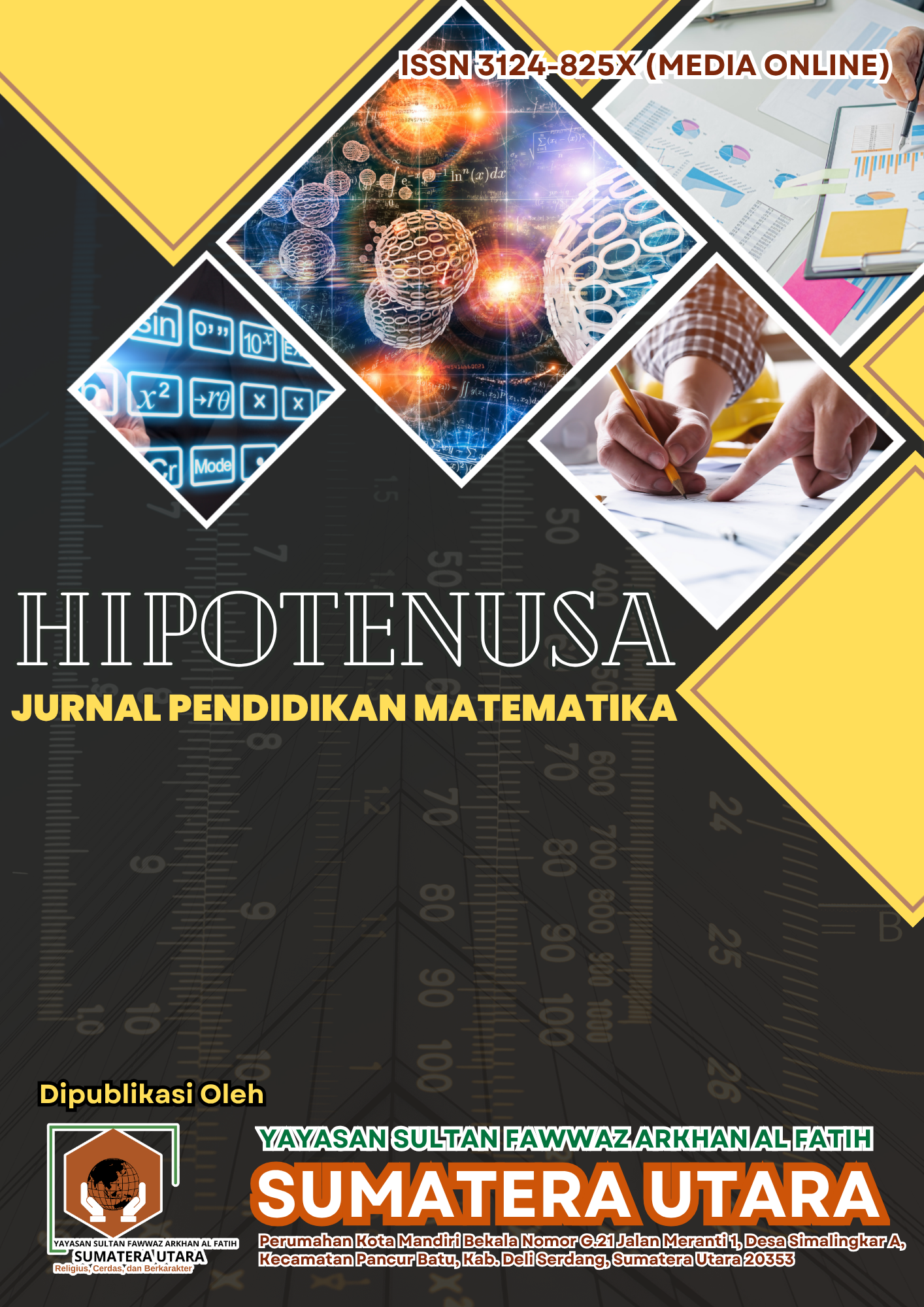
HIPOTENUSA: Jurnal Pendidikan Matematika is a scientific, peer-reviewed, and open access journal published by Yayasan Sultan Fawwaz Arkhan Al Fatih. The journal is published quarterly in February, May, August, and November.
HIPOTENUSA aims to provide a national and international academic forum for researchers, educators, and practitioners to disseminate original ideas, research findings, and scholarly discussions related to mathematics education. The journal welcomes contributions from authors across countries and promotes the advancement of theory and practice in mathematics teaching and learning at various educational levels.
The journal publishes original research articles, development/design research, classroom-based studies, and literature reviews focusing on innovations and contemporary issues in mathematics education.
To maintain its focus and academic quality, the scope of articles published in HIPOTENUSA includes, but is not limited to, the following areas:
1. Methods, Models, Strategies, Media, and Multimedia in Mathematics Learning
This scope covers research on the development, implementation, and evaluation of various instructional methods, learning models, teaching strategies, learning media, and multimedia designed to enhance students’ understanding, engagement, and achievement in mathematics learning.
2. Curriculum and Instruction in Mathematics Education
This area focuses on studies related to curriculum design, curriculum implementation, learning trajectories, lesson planning, and instructional alignment in mathematics education across primary, secondary, and higher education levels.
3. Assessment and Evaluation in Mathematics Learning
This scope includes research on formative and summative assessment, diagnostic assessment, evaluation models, test development, and assessment instruments aimed at measuring students’ mathematical understanding, skills, reasoning, and higher-order thinking.
4. Professional Development of Mathematics Teachers
This scope addresses research on the development of teachers’ competencies, pedagogical content knowledge, beliefs, and reflective practices, including pre-service and in-service teacher education in mathematics.
5. Ethnomathematics in Mathematics Education
This area emphasizes studies that explore the integration of cultural values, local wisdom, and socio-cultural contexts into mathematics learning, highlighting the role of culture in shaping mathematical thinking and instruction.
6. Information and Communication Technology (ICT) in Mathematics Learning
This scope includes research on the use and development of ICT-based learning tools, digital media, learning platforms, and educational technologies that support effective and innovative mathematics teaching and learning.
HIPOTENUSA is committed to disseminating high-quality research that contributes to the development of mathematics education theory, practice, and innovation, and serves as an open access platform to ensure wider visibility and impact of published works.